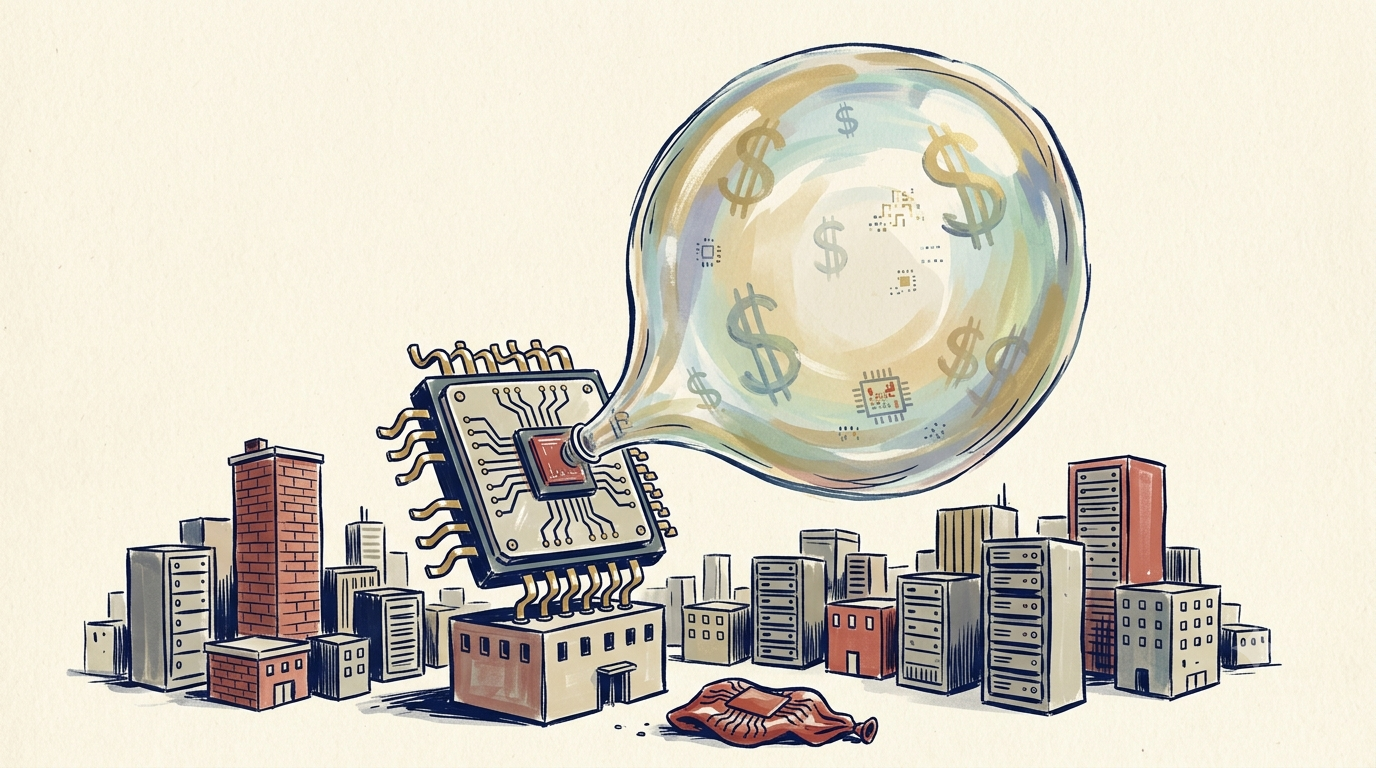
This week, I would like to come back to a word that has been circulating with increasing frequency in the financial press, and increasing discomfort in boardrooms: bubble. Not whether we are in one. The Bank for International Settlements, an institution not given to hyperbole, now says as much in its own Annual Report. What matters is what, if anything, survives when it bursts.
Start with the discomfort. J.P. Morgan’s capex analysts have done the arithmetic that Silicon Valley would rather not confront: earning a 10% return on the roughly $5 trillion the industry plans to spend on AI infrastructure through 2030 would require something in the order of $650 billion of new annual revenue, in perpetuity. The BIS frames the same imbalance in its own terms, noting that the five largest hyperscalers alone are on track to spend over a trillion dollars on AI capital expenditure between 2025 and 2026, an outlay it describes as outpacing both earnings and free cash flow. John Hussman, whose valuation work has tracked market cycles since 1928, adds a longer lens: on the metric he has found most reliably correlated with subsequent market returns, the ratio of nonfinancial market capitalization to gross value added, US equities now sit at their most extreme reading in a century, rivalling 1929 and 2000. Ten companies, he notes, make up 40% of the S&P 500. Layer on top of that the fact that a meaningful share of the revenue propping up today’s prices is circulating between a handful of counterparties rather than reaching independent customers. The BIS is unusually direct about this too, describing how chip makers and hyperscalers take equity stakes in AI labs and neocloud providers who, in turn, commit to buying the chips or compute back, a loop that now accounts for a sizeable share of sector wide financing, on terms that are typically poorly disclosed.
The cracks are no longer theoretical. Oracle, whose backlog is nearly half dependent on a single counterparty’s success, has fallen roughly 40% this month on fears that its cash burning buildout is outrunning its ability to fund it. And in a small irony that tells you everything about where we are in the cycle, Meta and Alphabet, companies that have spent two years insisting they could never buy enough compute, are now exploring ways to rent out their surplus capacity to others, a business model that only makes sense once you suspect you have built more than you need.
And yet, here is the uncomfortable part, it is precisely this exuberance that is funding what would otherwise be uninvestable. OpenAI generates perhaps $20 billion a year against $1.4 trillion in compute commitments. No sober capital allocation process, discounting cash flows the way business school teaches, would have funded the current buildout on its own merits. Bubbles are how genuinely transformative but genuinely unprofitable technologies get built anyway, and even the BIS concedes that AI carries real promise for productivity even as it warns that the current pace of investment could prove unsustainable. There is a second, quieter distortion helping the illusion along. Investor Michael Burry (about whom I have already written in this blog) has argued that hyperscalers are depreciating their chips over five to six years when the real economic life is closer to two or three, which by his estimate would mean something like $176 billion in overstated profits hiding in the footnotes between 2026 and 2028.
When this bubble bursts, though, the pain will travel further than it did in 2000. The reason is structural. The BIS points out that US stocks now make up close to two thirds of the MSCI Global index, and that household equity exposure has grown substantially relative to both wealth and income, meaning a US led correction would ripple outward and hit consumption harder than past ones did. Unlike the dot-com bust, financed overwhelmingly by equity investors who simply lost money they had chosen to risk, this buildout increasingly leans on debt. The BIS flags the expanding footprint of private credit specifically, noting that direct lending funds have quadrupled their exposure to AI and information technology over the past five years to around 15% of their portfolios. When the capex flow eventually dries up, it will not just be shareholders who feel it. It will be bondholders, insurers, and, through private credit quietly threading into pension books, savers who never chose to make the bet at all.
And yet, for society as a whole, if not for the individual investor, history is oddly reassuring, and the BIS itself makes the comparison explicit. Looking back at the canal mania of the 1830s, the British railway mania of the 1840s, the electrification exuberance of the 1920s, and the dot-com boom, it observes that each shared the same essential trait: a genuine technological breakthrough that attracted far more capital than commercial returns could ultimately justify, and each ended in a reversal that today’s AI boom now resembles in scale and pace. Andrew Odlyzko has called Britain’s Railway Mania the greatest technology mania in history by several measures, one whose collapse ruined a generation of middle class investors even as the surviving track became the skeleton of a century of industrial growth. The dot-com bubble followed a similar script with fiber. Telecom firms buried more than 80 million miles of cable, most of it left dark when the crash came, and it was that very glut, sold for pennies out of bankruptcy, that made the cheap cloud and streaming economy of the 2010s possible. The same crash also nearly took down two companies that would go on to define the following two decades. Amazon’s stock lost around 90% of its value between 1999 and 2001, and few analysts at the time expected it to survive as an independent company, let alone become one of the most valuable in the world. Google, still a private startup when the bust hit, grew into the dominant search engine partly because so many well funded rivals simply disappeared, leaving the field wide open. Neither company was created by the bubble bursting, but both were shaped by it, tempered by a crash that killed off nearly everyone around them and left them the room to become what they are today.
Not every bubble leaves something behind, though. Tulip Mania is the useful counter-example. Anne Goldgar’s archival research found only a few hundred traders active in Haarlem, out of a population of over forty thousand, a narrow speculation among merchants rather than the national hysteria of legend. When it collapsed, it left nothing behind: no bulbs as infrastructure, no industry it created. William Janeway’s concept of the productive bubble is useful here. He argues that some bubbles fasten onto a genuine general purpose technology and leave behind railway tracks, power stations, or fiber optic cable, while others, tulips among them, never had a technology to leave behind in the first place.
Which brings me to the real distinction this time. Unlike track or dark fiber, the single most expensive asset in this buildout, the chip, is also the least durable one. GPU rental rates have already collapsed as newer generations arrive. The heritage of this bubble, if there is one, will not sit in silicon. It will sit in the power plants and grid upgrades built to feed it, in commoditized open weight models, in research and talent scattered across an economy that no longer has to relearn what this generation already knows. The chips will be landfill. The rest, quite possibly, will still be running the world in 2040.