“Humor is reason gone mad.” – Groucho Marx
This week, I want to talk about a subject that is rarely addressed seriously in the professional world: humor at work. No business school, at least to my knowledge, offers courses on the topic. No competency framework lists it. No annual review form has a box for it. Yet I am convinced that humor, when used well, can help identify talent, build team cohesion, and improve collective performance. The academic literature, relatively sparse on the question, tends to support this view. Here is why.
Recruitment processes are designed to assess a candidate’s intellectual and behavioral capacity to handle the responsibilities they will face. To do so, companies and headhunters rely on a battery of cognitive tests, case studies, and situational exercises. These tools have real value. But they tend to capture a fairly narrow slice of what makes someone effective in a leadership role. Yet a future manager’s ability to produce humor, to use the academic term, in harmony with their context, is a remarkably powerful demonstration of intelligence in multiple forms, and one that no standardized test has yet managed to replicate.
Humor does not merely draw on intellectual agility. Managing with humor mobilizes cognitive and emotional components that range from reading the context to defining the intended effect, from skillful delivery to interpreting the reactions of others, all in a fraction of a second. This is what we broadly refer to as wit. That last skill is particularly useful for distinguishing genuinely positive reactions from surface-level compliance, which, over time, can generate a significant hidden emotional cost. A team that laughs out of obligation is sending a signal that a good manager should be able to read.
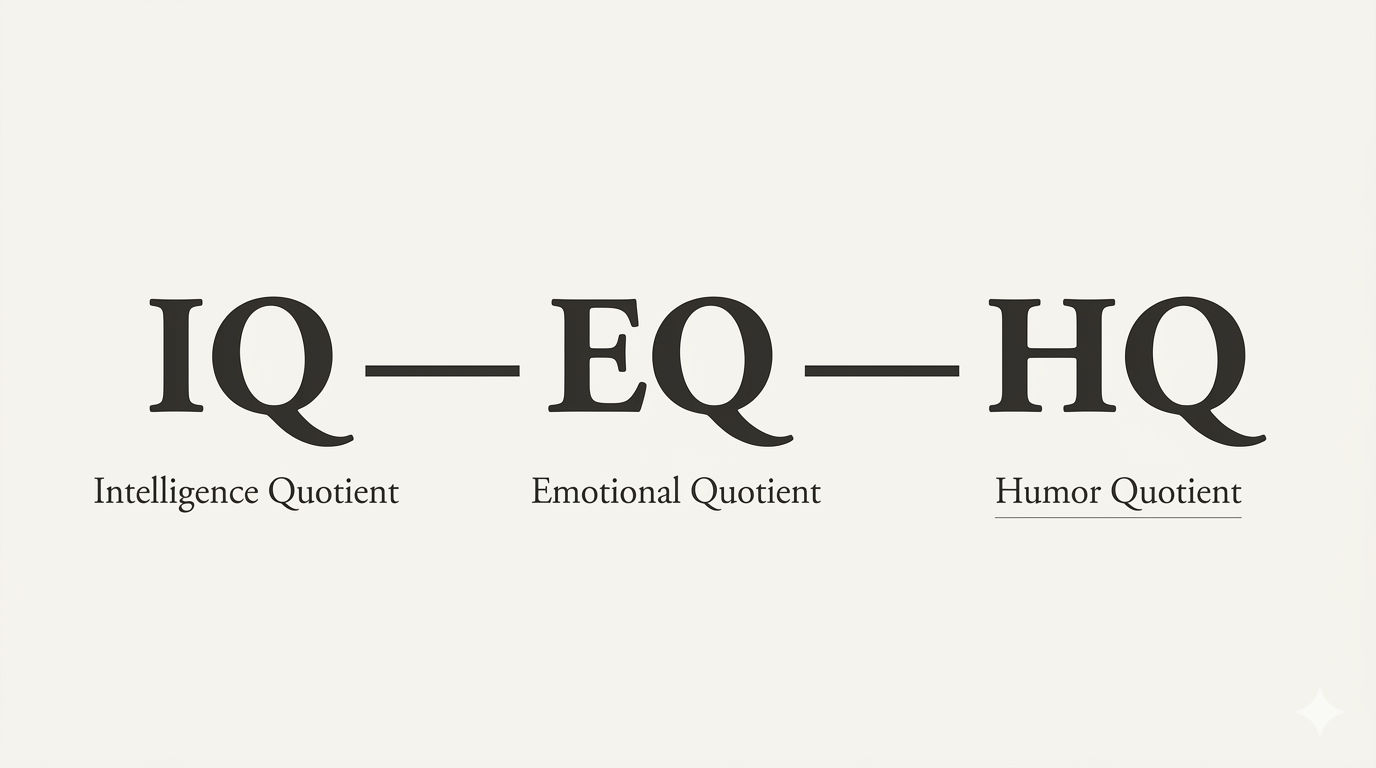
The exercise is so complete that some researchers have developed the concept of a humor quotient, combining the ability to be funny, to recognize humor in others, and to anticipate the reactions of one’s audience, a skill set not far removed from certain dimensions of emotional intelligence. A high humor quotient does not mean cracking jokes at every opportunity. It means understanding the social and emotional texture of a room, and knowing precisely what to do with that understanding.
To assess this competence during a recruitment process, it obviously does not suffice to ask a candidate to tell a joke. The process is far more subtle. Personally, I always try to create a relaxed but professional atmosphere during interviews, to see whether my interlocutor’s comic sensibility naturally aligns with mine. The question is not whether they are funny. It is whether they are attuned.
And even when you do not deliberately venture onto this terrain, you may find yourself unconsciously on the receiving end of it. It has been shown that recruiters pay greater attention to candidates who present their skills with a touch of humor, provided it is well enough calibrated not to undermine their credibility. This is the concept of humorbragging: the ability to signal competence through wit rather than through straight assertion. The same study concludes that startup founders use the same mechanism to attract investment more easily. In a world where attention is scarce and first impressions are durable, being memorable in the right way matters.
Once inside the organization, humor is often described as a lubricant for interpersonal relationships. In leaders, it can generate positive emotions within teams, strengthen trust, encourage proactive behaviors toward the organization, and stimulate creativity. The mechanism is well-documented: humor signals psychological safety, and psychological safety unlocks the kind of candid, high-quality exchange that drives performance. Other studies show that these positive spirals tend to be self-reinforcing. Teams that laugh together tend to perform better, and teams that perform better tend to find more to laugh about.
The Harvard Business Review has dedicated an article to the subject, identifying four humor styles practiced at work, from the bold ‘stand-up’ stance to the sarcastic ‘sniper’ style. The central argument: not all styles are equivalent in their effects on a team, and the choice of style reflects directly on the person who deploys it.
That said, humor is not a panacea. Research shows it is only effective if a foundation of trust already exists within the team. In uncertain or high-pressure environments, reaching for humor can be simply counterproductive. Timing, as in comedy itself, is everything.
Using humor at work therefore requires considerable deftness, and several pitfalls await the poorly calibrated practitioner.
The first is contextual. A Swiss private bank will probably not tolerate the same humor, nor in the same quantities, as an American startup. Some companies, like Southwest Airlines, have even embedded the principle of don’t take yourself too seriously into their official code of conduct, which is not trivial. Culture shapes what is funny, what is acceptable, and what lands badly. Having lived in the United Kingdom, Switzerland, and now Belgium, I can say that my brain switches registers quite deliberately when I need to deploy humor in each of these three countries. The British understatement, the Swiss caution, and the Belgian surrealism are not interchangeable.
The second pitfall is qualitative. Martin’s taxonomy distinguishes affiliative humor from aggressive humor: insults, discrimination, harassment dressed up as lightness. This second type has no place at work, and the psychological, reputational, or disciplinary consequences of a poorly judged remark can be severe. The line between edgy and offensive is real, and context-dependent, and crossing it accidentally does not make the consequences any less serious.
The third is one of dosage. Relying too heavily on humor to get every message across exposes one to a loss of credibility, particularly in contexts that call for seriousness. Like any rhetorical device, humor derives much of its power from scarcity. Use it constantly and it loses its effect; deploy it at the right moment and it can shift the entire energy of a room.
I am a firm believer in the use of controlled humor at work, in both quantity and quality. It allows one to defuse situations, to breathe in the middle of intense intellectual sessions, to land difficult messages, to test hypotheses before diving in. Think of it less as entertainment and more as a management instrument: a way of taking the temperature of a room, of opening a door that a direct question might have kept shut, of signaling to a team that their leader is human without sacrificing an ounce of authority. It also reveals, beneath the surface, something essential about both the person who uses it and the person who receives it: a window onto personality that few management tools offer with such naturalness.
The real skill is not being funny. It is knowing when, how, and how far.