
Far from the tumult of global stock markets and heavily publicized geopolitical news, the hushed world of private assets is beginning to shake at its foundations. Rising interest rates, seizing liquidity, sector-wide tremors driven by both technological progress and exogenous shocks — the stress is real and mounting. But the most important story is not the stress itself. It is the set of mechanisms that private markets have quietly developed to defer loss recognition rather than absorb it. Continuation funds, withdrawal gates, Payment in Kind — each individually defensible, collectively a system for kicking the can. When the can finally stops, the consequences will extend well beyond the institutional investors involved.
On the private equity side, fund managers are making increasing use of continuation funds, which allow them to bring in new investors to buy out the positions of others, thereby sustaining a liquidity cycle. Managers thus act simultaneously as sellers (through their original fund) and buyers (through their continuation fund). This conflict of interest ought to invite skepticism. In 2025, continuation funds were used to realize 7% of exits, according to Bain & Co.’s annual Private Equity Report, a share that has grown steadily.
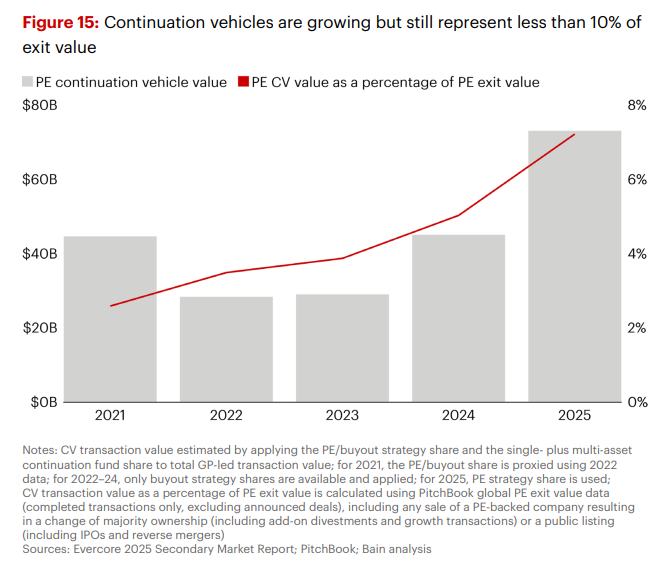
The mechanism has a legitimate origin. A fund whose holding period is constrained by its lifespan (typically 10 years) might otherwise be forced to sell a high-performing asset to a competitor precisely when it would be better held. A continuation fund solves that problem. But that noble rationale is increasingly being used as cover for a different purpose: avoiding the crystallization of losses on underperforming assets. The mechanics are the same; the direction of value transfer is reversed. New, less specialized investors (pension fund managers, by definition less expert in private equity than the managers whose entire business it is) absorb the positions that more informed capital no longer wants.
This is not a story of individual bad faith. It is a story of structural incentive. Manager compensation scales with assets under management. New capital, even recycled capital, extends the fee clock. The system rewards deferral.
The democratization of private equity, facilitated by favorable regulatory changes in countries such as France, has added a new dimension to this dynamic. Broadening access to private markets beyond wealthy individuals is a genuinely laudable goal. But it also enlarges the pool of less sophisticated capital available to absorb what more informed investors are exiting. The two trends (democratization and continuation fund growth) are not coincidental. They are complementary, and the direction of flow between them deserves scrutiny.
Private credit funds promise attractive returns on one fundamental condition: that capital remains invested and no massive market reversal occurs. Both conditions are now under pressure simultaneously (and the sector’s response reveals the same pattern of deferred reckoning).
The clearest trigger has been the fear that AI will displace large portions of the software economy. Salesforce, Oracle, and SAP, three of the sector’s most durable names, have fallen 44%, 50%, and 40% respectively from their all-time highs. These are public companies, and their stock prices are not direct evidence of stress in private credit portfolios. But they are a signal. Behind the giants sit hundreds of smaller, more fragile software businesses carrying private debt – businesses whose revenue assumptions were built in a different competitive environment. Their creditors know this. And they are trying to get out.
The problem is that they cannot, not quickly. Private credit funds are structurally illiquid. The result has been a wave of restricted withdrawals – including at major names such as Blue Owl, Blackstone, Cliffwater, Morgan Stanley, and BlackRock – with all the hallmarks of a bank run and the faint but unmistakable smell of 2008. The recent high-profile difficulties of portfolio companies such as First Brands have only sharpened the unease.
Into this picture enters Payment in Kind, or PIK – a mechanism whereby a borrower adds interest to the principal balance rather than paying it in cash. Properly used, PIK can be constructive: a high-growth company investing ahead of its cash flows has legitimate reasons to preserve liquidity. But PIK is increasingly being deployed not as a growth tool but as an insolvency mask. Without a cash payment demand, there is no technical default, and without a default there is no bankruptcy filing. The problem is not solved; it is reclassified. Allianz estimates that 40% of software companies using PIK fail to generate sufficient cash to cover basic operating costs, meaning that for a substantial share of these borrowers, PIK is not financing growth. It is financing survival, one deferred interest payment at a time.
Continuation funds defer equity losses. Withdrawal gates defer liquidity demands. PIK defers credit events. The mechanisms differ; the logic is identical.
Because the chain of exposure does not stop at the institutional level. Pension funds – among the largest investors in private equity and private credit – derive their capital from the retirement savings of ordinary individuals. Banks with exposure to these asset classes are funded, ultimately, by depositors. When the financing cycle wobbles, it is not abstract institutional balance sheets that suffer first. It is retirement plans that fall short of their promises. It is savings that turn out to be worth less than their reported value.
This is the dimension that makes the regulatory question urgent rather than merely technical. States are less able than in 2008 to play the role of lender of last resort: public debt levels in most developed economies leave far less fiscal headroom than existed before the financial crisis. The implicit backstop that allowed policymakers to contain the damage in 2008 is weaker today.
The question for investors and policymakers alike is therefore not whether private markets serve a useful economic function: when properly deployed, they do, and significantly. The question is whether the regulatory framework keeps pace with the sophistication of the deferral mechanisms that have developed within them. Three mechanisms, each defensible in isolation, have quietly assembled into a system optimized for one thing above all: making losses invisible for as long as possible.
The lessons of 2008 were hard-won. It would be a particular kind of irony if what we built in their wake turned out to be more resilient architecture – for the next crisis to hide in.