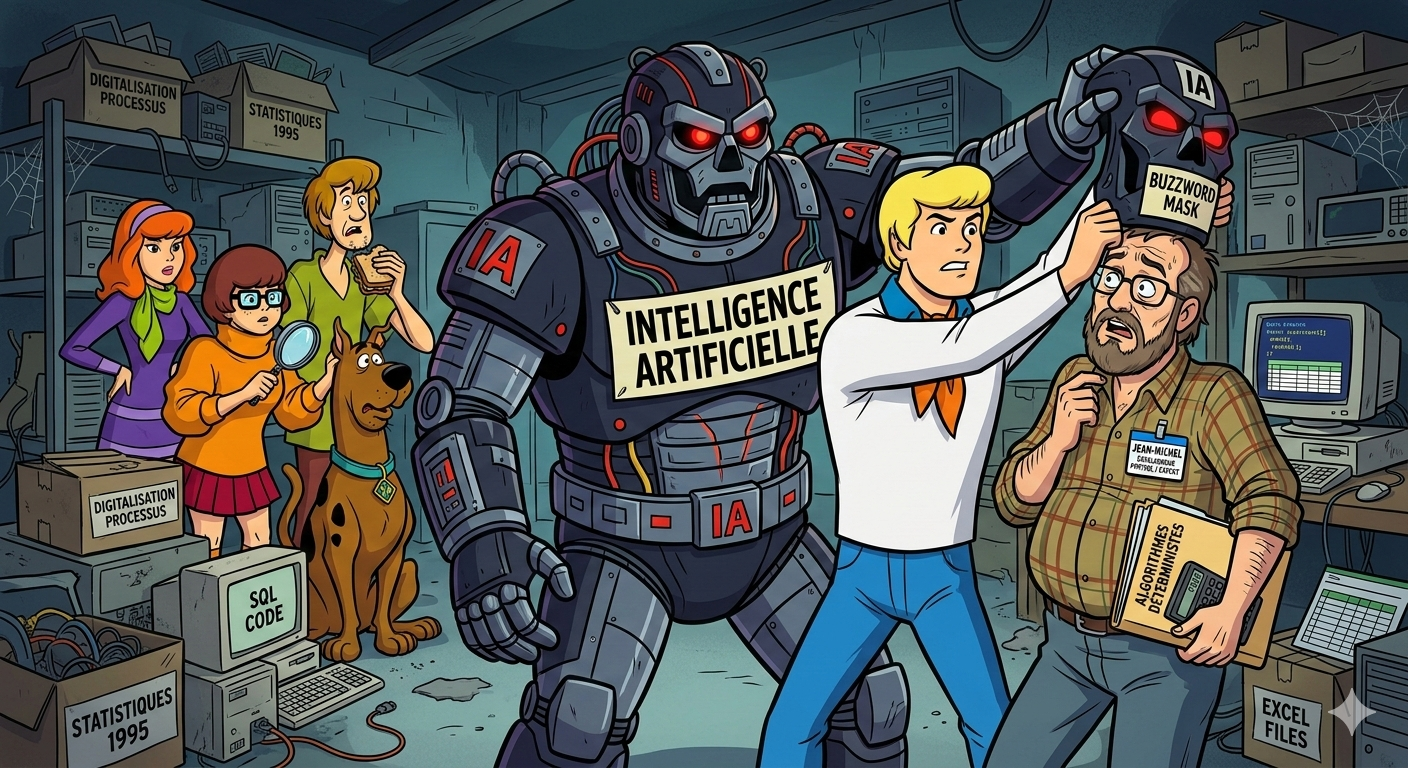
This week, I want to address the AI craze currently sweeping through our professional environments. Some companies, like Accenture, have moved so aggressively that they have reportedly begun tying promotions to AI usage. In this climate of extreme enthusiasm, powered by AI solutions are everywhere. However, we must be careful: while some offer truly groundbreaking features, others simply repackage decades old computing concepts in shiny new marketing. My goal here is to separate the wheat from the chaff and restore the credit due to digitalization, statistics, and classical algorithmics.
The most overused example is undoubtedly the chatbot. Promoters claim AI will soon replace all call centers globally. This prediction contributed to the 85% drop in Teleperformance’s stock price since ChatGPT debuted in 2022. While some AI chatbots offer truly original and context aware answrs, many simpler versions merely scan for keywords and match them against a static database (what computer scientists call Regular Expressions, or RegEx). The result is a frustrating experience where complex questions go unanswered because the intelligence is actually just a basic search filter.
Software vendors also frequently pitch AI as the eye that reads invoices. Yet, Optical Character Recognition (OCR) technology predates modern AI by nearly a century; devices like the Optophone, designed for blind people, were reading characters as early as 1914. What modern AI actually provides is a semantic layer that helps isolate specific fields, like a VAT number or an address. It is an improvement, but it is not a technological reinvention of the wheel.
Similarly, many AI tools are designed to automate internal processes. However, there is a distinct line between thinking like a human and acting in place of one. If a sequence of actions follows a set of predefined rules or a deterministic path, it is Robotic Process Automation (RPA). This is high quality digitalization, but it is not AI, even if the underlying rules are incredibly complex.
When a bank calculates a credit score, a company forecasts six month sales, or Amazon suggests your next purchase, they often call it AI. In reality, these systems rely on statistical analysis, such as linear regressions or Bayesian probabilities, applied to large datasets. This is the core of Big Data, a field driven by the explosion of computing power that matured years before the current AI wave. These are mathematical certainties rather than machine thinking.
AI is even presented as the only way to optimize inventory, delivery routes, or logistics. Yet, the algorithm your GPS uses to find the shortest path, Dijkstra’s Algorithm (from the name of its inventor, Edgser Djikstra), was first published in 1959. For decades, our only limit was hardware. The same increase in processing power that enabled the rise of AI also made these classic algorithms faster and more effective. One root cause, computing power, has led to two very different technological branches.
To maintain a critical perspective, decision makers can use three simple tests to identify facade AI. First, it is process automation if the system follows rules defined in advance. AI creates its own rules from data rather than needing a human to map every step. Second, it is statistics if the decision is fully explainable by a mathematical formula. Current Deep Learning models are often black boxes; if you cannot explain exactly why a decision was made, it might actually be AI. Third, it is likely algorithmics if the system works instantly without needing any training data.
In conclusion, while AI is a fascinating driver of transformation, it must not become the tree that hides the forest of computer and mathematical sciences. Its power does not replace the rigor of algorithmics, the precision of statistics, or the efficiency of determinism. These remain the pillars of robust, explainable, and cost effective solutions. A leader’s technological maturity lies in the ability to ignore the hype and choose the right tool for the job, whether that is a disruptive new AI or a scientific method that has been proven to work for decades.