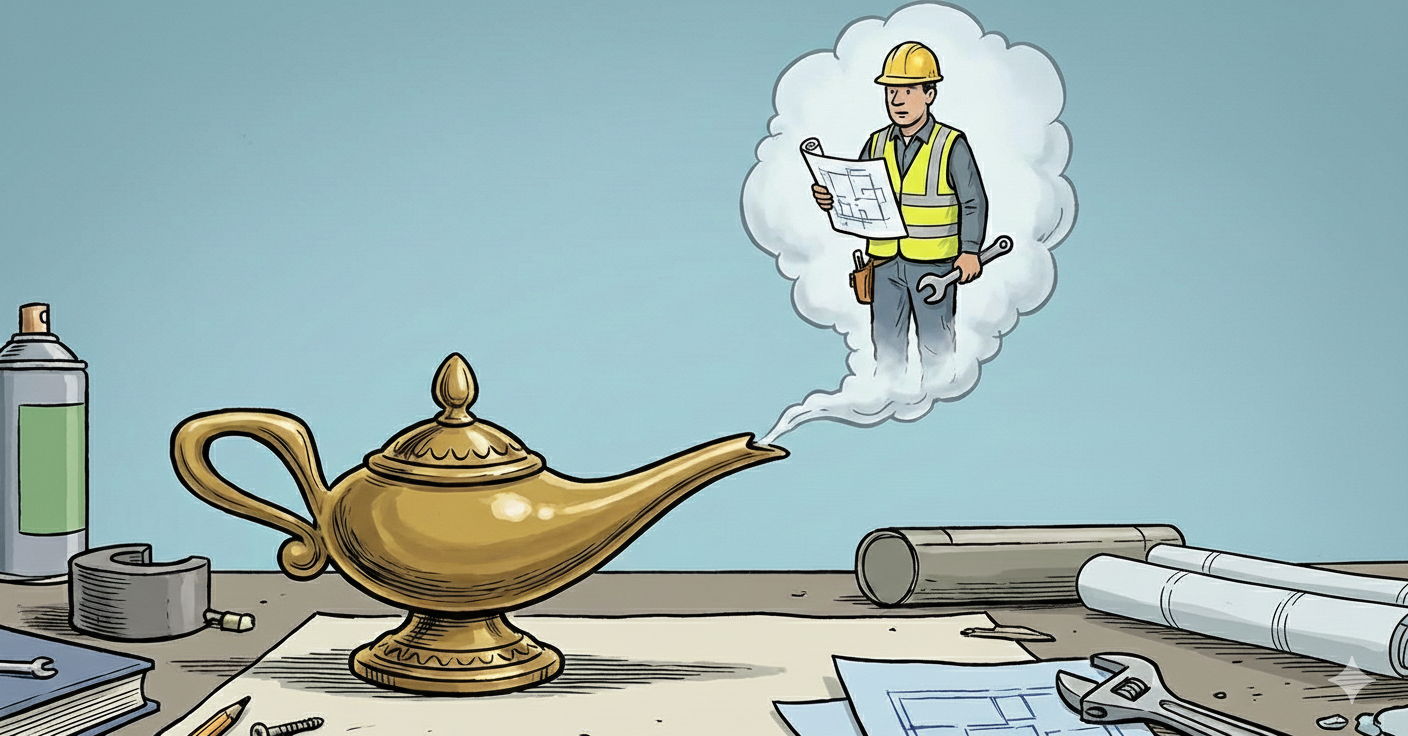
This week, I’d like to focus on a refrain we hear with every new breakthrough in artificial intelligence. The narrative suggests that the engineering profession is facing extinction, and that the question is not so much “if,” but “when” the craft will be superseded by the machine. Capable of churning out lines of code in seconds, simulating complex structures, or solving differential equations that once required hours of hard graft, AI does indeed seem to be striking at the very heart of the engineer’s trade. Yet, a more nuanced look at the history and practice of engineering suggests exactly the opposite. We are not witnessing a substitution, but a profound transformation where the engineer, far from vanishing, is becoming the vital pivot of an increasingly automated world.
To understand the current state of play, we must look in the rearview mirror. Historically, the engineer is the one who deploys their “genius” to design “engines.” In the era of Vauban, he was a versatile master builder, blending military art, geometry, and a keen sense of the landscape. His strength lay in his ability to tame physical territory. With the Industrial Revolution, the profession shifted towards mathematical precision and theoretical physics. The engineer became the high priest of calculation and thermodynamics—the one who turned steam and steel into motion through absolute mastery of the slide rule. In the 20th century, the role specialised further into the optimisation of complex systems and the management of invisible flows. Today, with the rise of AI, the engineer is undergoing a new metamorphosis. He is finally shedding the skin of the “calculator” to become the guarantor of meaning and coherence. His value no longer lies in his capacity to produce a technical result, but in his authority to validate and direct it.
One of the first major upheavals concerns the shift in where value is added. For decades, the core of the work consisted of finding solutions to more or less complex problems. AI is now saturating our minds with near-instant solutions to segmented tasks, pushing the engineer’s added value outwards towards two specific areas. The first, upstream, involves defining the need with surgical precision. I would place the “craft” of the prompt engineer in this category—someone who must translate a messy real-world problem into a synthetic, structured format. The second, downstream, stems from the engineer’s ability to vet the accuracy of the result “served up” by the machine—to judge whether it is credible and to arbitrate between various proposed solutions by adopting a robust, quantitative decision-making framework. This is a way of structuring thought that I believe is equally applicable to professions often perceived as more “literary.”
Indeed, the generative power of AI conceals a formidable pitfall: the “black box” challenge. Behind its surface-level confidence, AI can generate inaccurate, or even absurd and dangerous solutions, particularly when exploring the frontiers of innovation. When the algorithm is put to the test on uncharted ground, where training data is too scarce to feed the statistics, “hallucination” is never far away. In this context, the engineer becomes an indispensable safeguard. The human value of the engineer follows a logic of communicating vessels: the more massive the production of automated solutions becomes, the more valuable physical intuition and the ability to spot errors become. Moreover, only human consciousness can arbitrate by weighing the many facets of a problem: safety, cost, environmental impact, and so on. Beyond the technical, it is the human, not the machine, who bears the legal and moral responsibility—as several now-famous legal precedents remind us.
This new reality demands a radical revolution in how we train future engineers. If we are to prevent them from becoming hostages to their tools, education must move from resolution to diagnosis. Mastering theoretical fundamentals in physics and mathematics remains vital—not to perform the calculation, but to be capable of confirming or debunking the AI’s reasoning. As I have noted several times on this blog, critical thinking and reasoning skills will be among the essential tools for tomorrow’s professionals.
Finally, there is a territory where the algorithm invariably trips up: that of the unforeseen and disruptive innovation. By definition, AI is conservative; it relies on statistical models and past data to generate its answers. It excels at recombining what already exists, but it struggles to invent that which has no precedent. The engineer, however, remains the engine of disruption. He possesses that unique capacity for imagination which transcends the existing and which is, in essence, necessary for any true invention.
In conclusion, artificial intelligence is not replacing the engineer. On the contrary, this new form of intelligence frees him from the “brute force” of calculation to return him to his original and most noble mission: to design and validate viable solutions in an uncertain world. The engineer of tomorrow is no longer the one racing the machine to match its speed. He is the one who, standing before the overflowing proposals of the algorithm, knows how to say with certainty why one option is the right path and why another is a dead end, a mirage, or even a trap. He is the master of judgment, the one who gives meaning to computational power. More than ever, in a century saturated with data and automation, we need these architects of reality to ensure that technology remains at the service of humanity.